Is CBD Legal? A State-by-State Guide (2026)
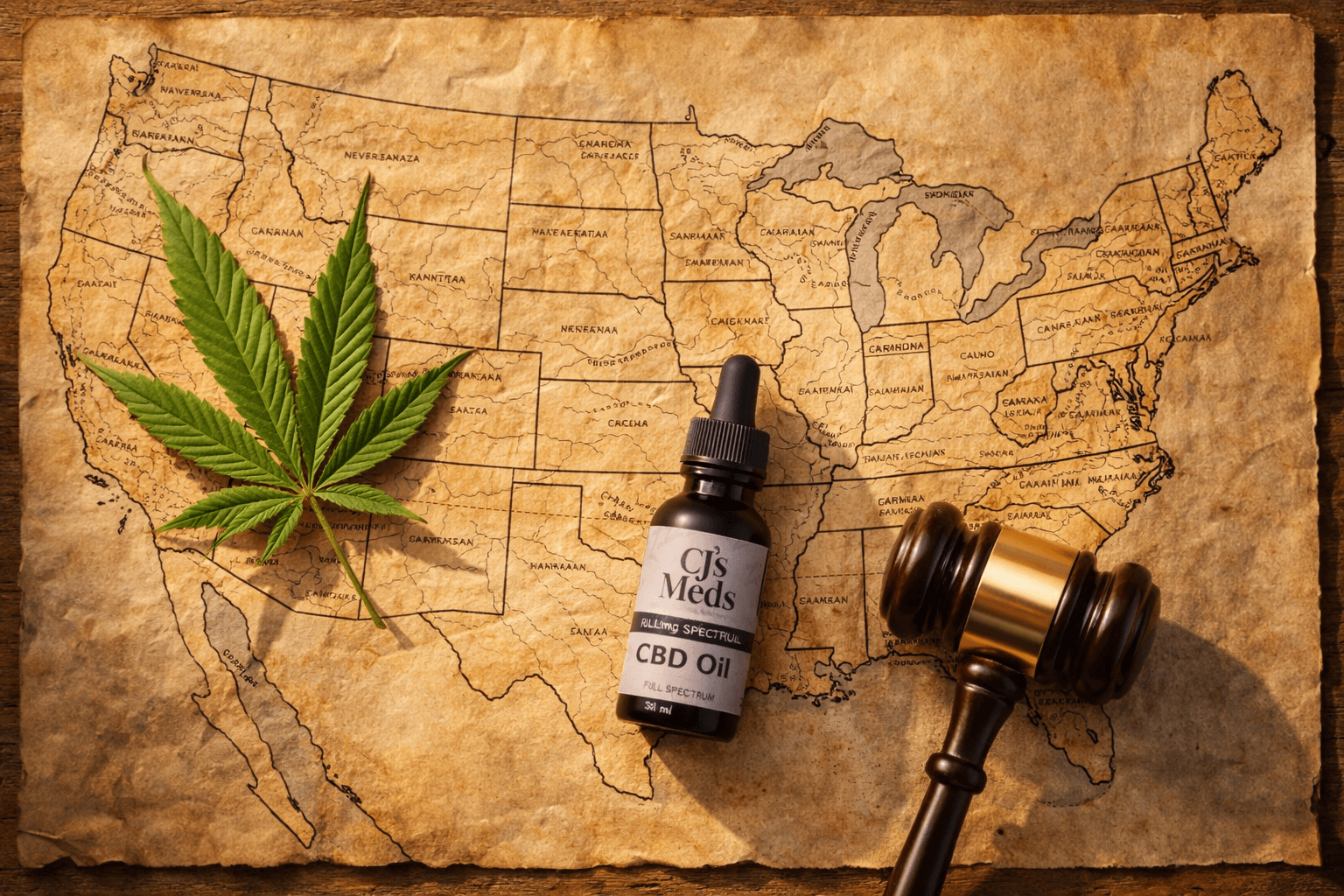
The legality of CBD in the United States is complicated. While the 2018 Farm Bill federally legalized hemp-derived CBD, individual states have their own rules. Here is what you need to know.
Federal Law: The 2018 Farm Bill
The Agriculture Improvement Act of 2018 (commonly called the Farm Bill) removed hemp from the Controlled Substances Act and legalized the cultivation, processing, and sale of hemp and hemp-derived products, including CBD, at the federal level.
The key distinction: Hemp is legally defined as cannabis containing 0.3% THC or less by dry weight. Cannabis containing more than 0.3% THC remains classified as marijuana under federal law and is a controlled substance.
This means:
- Hemp-derived CBD (under 0.3% THC): Federally legal
- Marijuana-derived CBD (over 0.3% THC): Federally illegal, though many states have legalized it
FDA Regulation
The FDA has not yet established a regulatory framework for CBD in food and dietary supplements. As of 2026:
- CBD cannot be marketed as a dietary supplement or added to food products under current FDA rules (though enforcement has been minimal)
- The FDA has approved one CBD drug: Epidiolex (for certain epilepsy conditions)
- The FDA has sent warning letters to companies making unauthorized health claims about CBD
- Many in the industry expect the FDA to establish formal CBD regulations, but no timeline has been set
Despite the regulatory gray area, the CBD market operates openly across most of the country with state-level oversight.
State-by-State Overview
Fully Legal (No Significant Restrictions on Hemp CBD)
The majority of states allow the sale and possession of hemp-derived CBD with no significant restrictions beyond the federal 0.3% THC limit:
Alabama, Alaska, Arizona, Arkansas, California, Colorado, Connecticut, Delaware, Florida, Georgia, Hawaii, Illinois, Indiana, Kansas, Kentucky, Louisiana, Maine, Maryland, Massachusetts, Michigan, Minnesota, Missouri, Montana, Nebraska, Nevada, New Hampshire, New Jersey, New Mexico, New York, North Carolina, North Dakota, Ohio, Oklahoma, Oregon, Pennsylvania, Rhode Island, South Carolina, South Dakota, Tennessee, Texas, Vermont, Virginia, Washington, West Virginia, Wisconsin, Wyoming
States with Additional Restrictions
Idaho: Allows hemp-derived CBD only if it contains absolutely zero THC (not 0.3%, but 0.0%). Full spectrum products may not be compliant. Broad spectrum or isolate products with verified zero THC are recommended.
Iowa: Allows CBD but requires products to contain no more than 0.3% THC and to be sold by licensed retailers. The state has specific labeling requirements.
Mississippi: Legalized hemp CBD in 2020. Products must comply with federal hemp guidelines and state labeling requirements.
Utah: Legal but requires CBD products to be registered with the state Department of Agriculture and Food. Unregistered products may be seized.
Key Factors That Affect Legality
THC Content
The 0.3% THC threshold is the most important legal distinction. Full spectrum CBD products containing up to 0.3% THC are legal in most states. However, some states set the threshold lower (Idaho requires 0.0%).
Source (Hemp vs. Marijuana)
CBD derived from hemp (under 0.3% THC) has a different legal status than CBD derived from marijuana (over 0.3% THC). Even in states where marijuana is legal, the regulatory frameworks may differ.
Product Type
Some states have restrictions on certain product types:
- Smokable hemp: Some states (like Indiana and Louisiana) have banned or restricted smokable hemp flower
- CBD in food/beverages: Some states follow FDA guidance more strictly and restrict CBD in food products
- CBD for pets: Generally unregulated but not FDA-approved for animal use
Labeling Requirements
Many states require CBD products to include:
- Total CBD and THC content
- Batch/lot numbers
- Third-party lab test results or QR codes to COAs
- Manufacturer information
- Warning statements (varies by state)
Traveling with CBD
Domestic Travel
You can generally fly with hemp-derived CBD within the United States. The TSA updated their policy in 2019 to allow FDA-approved CBD products and hemp-derived products containing no more than 0.3% THC. However:
- Keep products in original packaging with clear labeling
- Carry a Certificate of Analysis (COA) if possible
- Be aware of the laws in your destination state
- TSA agents are not actively searching for CBD, but if they find it during a routine search, they may refer it to local law enforcement
International Travel
Do NOT travel internationally with CBD. Many countries have strict cannabis laws that do not distinguish between hemp and marijuana. Countries where CBD is illegal or heavily restricted include Japan, China, Russia, UAE, and many others. Even countries where CBD is technically legal may have different THC thresholds or require prescriptions.
Workplace Drug Testing
Even though CBD is legal, drug tests screen for THC, not CBD. Key points:
- Full spectrum CBD contains trace THC (up to 0.3%). At normal doses, this is very unlikely to trigger a positive test, but it is not impossible, especially at high doses or with very sensitive tests
- Broad spectrum CBD has THC removed and carries lower risk
- CBD isolate contains zero THC and carries the lowest risk
- If your job requires drug testing, discuss CBD use with your employer and consider broad spectrum or isolate products
- Some employers now distinguish between hemp-derived CBD and marijuana use in their drug policies
Our Commitment
All CJ's Medicine Cabinet products are made from hemp grown in compliance with the 2018 Farm Bill. Our products contain 0.3% THC or less (full spectrum) or non-detectable THC (broad spectrum). Every batch is third-party tested, and Certificates of Analysis are available for all products. Browse our shop to see our full spectrum and broad spectrum options, all compliant with federal hemp law.
If you have questions about CBD legality in your area, contact us at help@cjsmeds.com and we will do our best to help.
This article is for informational purposes and is not legal advice. Laws change frequently. Always verify current laws in your specific state or jurisdiction.